
What are reFuels and how do the terms „HVO“ and „E-Fuel“ relate to each other?
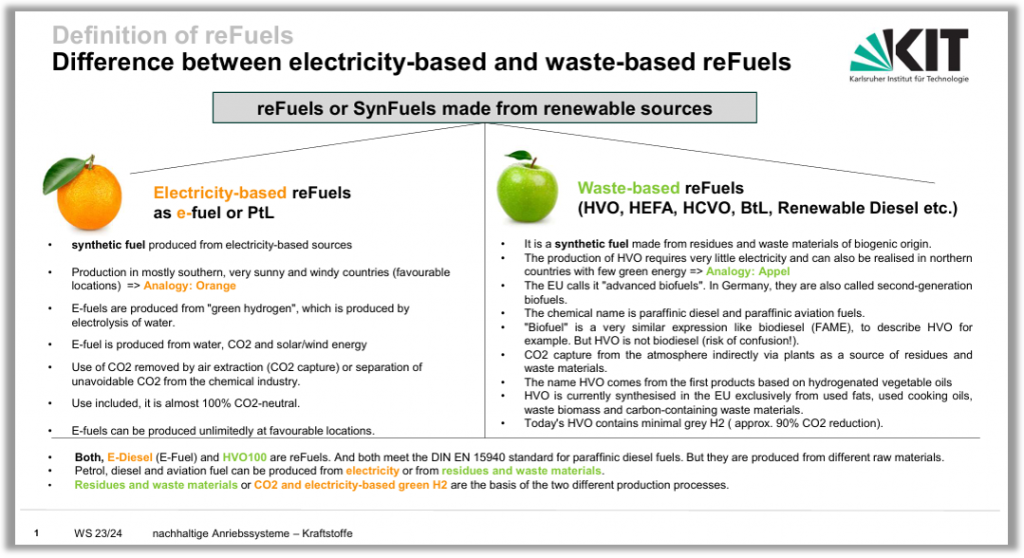
Dr.- Ing. Olaf Toedter: The term ‘reFuels’ is a combination of words and describes the sum of fuels that can be produced from renewable sources and used in existing infrastructure. HVO, which is produced from residual and waste materials, and is one example of these fuels. Waste that already contains a great quantity of energy is used in its production. Very little additional hydrogen is required. As a result, less energy is needed for HVO than for e-fuels (power-to-liquid, PTL). An example of the PtL approach are Fischer-Tropsch fuels, which are synthesised in locations with abundant sun and wind. As diesel fuels, both fuels comply with DIN EN 15940 for paraffinic diesel. The following graphic from KIT in Karlsruhe describes the reFuel term in more detail. Electricity-based fuels, known as e-fuels, also belong to the reFuels category. The KIT diagram shows an analogy with an apple and an orange. E-fuels are preferably produced in sunny and windy countries, mostly in the south (analogy: orange). In contrast, HVO requires little electricity and can therefore also be produced in northern countries (analogy: apple).
Note from eFuelsNow::
The map displays the following reFuels:
=> HVO diesel fuels
=> Bionaphtha-based gasoline
=> E20 gasoline (ethanol, first-generation biofuel)
E-fuels (gasoline and diesel) will also be displayed in the future (date unknown).

What are the differences between HVO and biodiesel?
Prof. Dr- Ing. Thomas Willner: Both are diesel substitute fuels. However, they differ chemically. Biodiesel fuels are fatty acid methyl esters (FAME), which still contain approx. 11% oxygen by weight in their molecules. These comply with DIN EN 14214. HVO (hydrotreated vegetable oil) consists exclusively of pure liquid hydrocarbons. These do not contain any oxygen. Unlike biodiesel, pure HVO fuel has a virtually unlimited shelf life and complies with DIN EN 15940. It does not contain any aromatics. HVO is clear as water, almost odorless, and burns cleaner than biodiesel or fossil diesel. It is also resistant to diesel pest and can be used in its pure form in conventional diesel engines without any problems. Biodiesel cannot be used in its pure form in conventional diesel vehicles unless they are prepared for it.
Are there also fuel-based alternatives (similar to HVO) for gasoline engines?
Dr.-Ing. Olaf Toedter: Yes, there are fuels based on residual materials for gasoline engines as well. Until now, E10 fuel has mostly been supplemented with bio-naphtha. Gasoline fuels can be produced both via the PtL route (here mostly via e-methanol) and via the BtL route (biomass-to-liquid). Bio-methanol based on biogenic residues and waste materials, for example, is a basis for both synthetic gasoline fuel from bio-naphtha and gasoline fuels produced from methanol gasoline. Gasoline engines have higher knock resistance requirements.
Note eFuelsNow: You can also find gas stations offering these types of fuel in the app.
How efficient is HVO?
Prof. Dr.- Ing. Thomas Willner: First, it must be clarified what kind of efficiency is meant. In terms of cost, time, electricity, CO2 savings, and resource efficiency, HVO is unrivaled. Existing diesel vehicles can contribute to climate protection immediately without significant time investment, without engine conversion, and using existing infrastructure. This maximizes cost, CO2 savings, and resource efficiencies. Even in terms of electricity efficiency (kWh/km), HVO is around 2-4 times better than e-mobility, even if electricity-intensive electrolysis hydrogen is used for its production in the future. This is because waste raw materials already contain a lot of energy. Therefore, only a small amount of additional energy is required for fuel production.
How efficient is e-fuel?
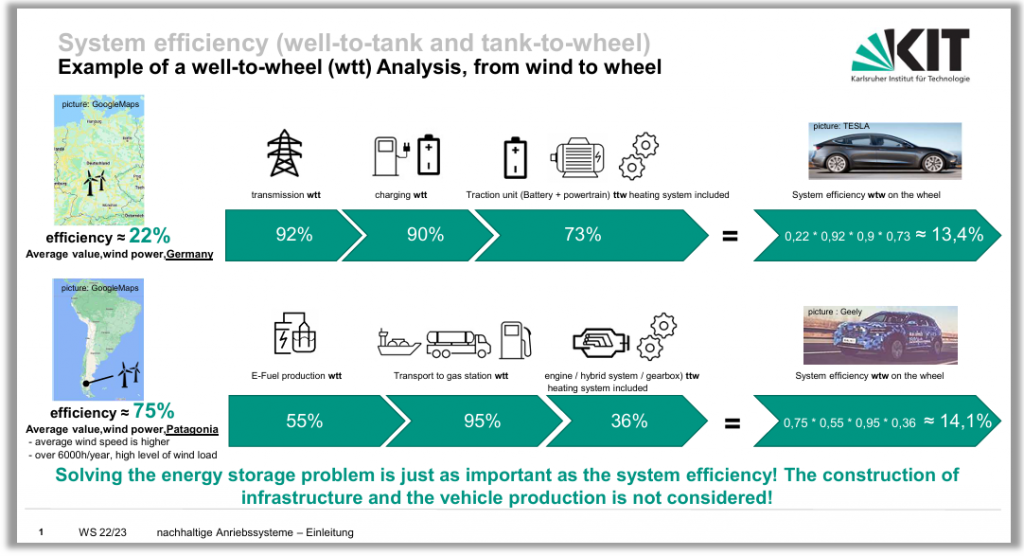
Dr. -Ing. Olaf Toedter: The term “efficiency” has several meanings. In terms of costs, time, and resources, e-fuel is an efficient fuel, as closed carbon cycles in existing infrastructure contribute immediately to climate protection. However, e-fuels (PtL Power-to-Liquid) require a lot of electrical energy for hydrogen electrolysis. CO2 from the air is collected via direct filtering (direct air capture DAC or from industrial plants). This is used to produce an energy carrier with high energy density. The electrical energy required for this should be used in favorable locations, i.e., locations with high wind and solar yields.
Many efficiency calculations are based on the assumption that e-fuel would be produced in Central Europe (e.g., in Germany). But for yield reasons, this would only make sense at a few locations. At these favorable locations, the significantly higher yield factor counteracts the conversion losses. From a global perspective, there is no lack of energy from renewable sources. The main challenges are transportation and energy storage. In this case, the energy is stored as fuel. Even with directly used electrical energy, losses due to conversion and auxiliary equipment must be taken into account.
Note from eFuelsNow: Electricity is a very valuable form of energy, instantly usable energy that doesn’t occur naturally. Electricity always requires pre-transformation, which inevitably results in losses. Whether these thermodynamic processes take place under the hood of a car or on the outskirts of a city is completely irrelevant.
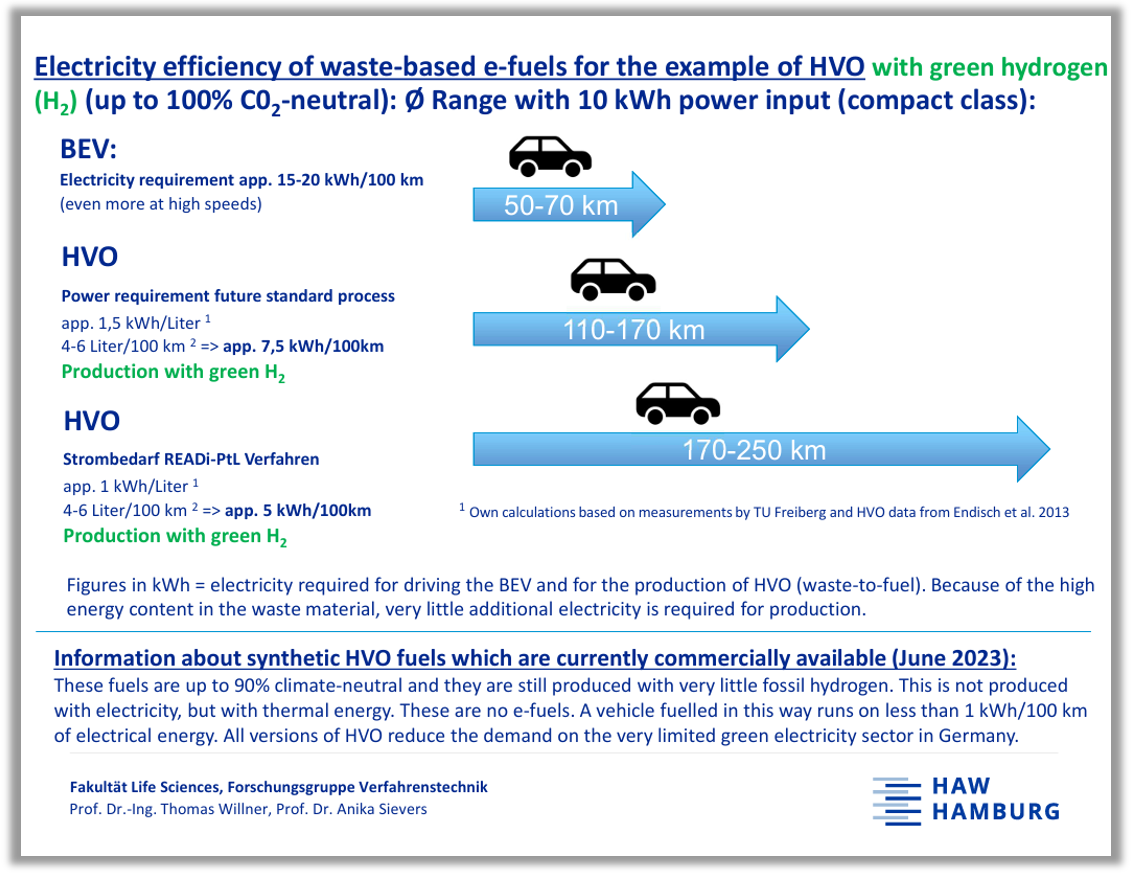
In the picture: Consideration of HVO produced with green H2 in the future (=> HVO with green H2 produced conventionally and by READi process). Comparison with BEV => Possible driving distance with 10 kWh electricity consumption.
In the Text: HVO diesel fuels currently available on the market require very little electricity to produce. Because the residual material already contains a lot of energy, very little electricity is needed during HVO production. This results in extremely high electricity efficiency when driving (less than 1 kWh/100 km). Even HVO made from green H2 is already more electricity-efficient than an electric car.
Source: HAW Hamburg, Prof. Dr.-Ing. Thomas Willner
Are reFuels also used in aircraft? Wouldn’t it be more sensible to concentrate solely on the marine and aviation sectors?
Prof. Dr.- Ing. Thomas Willner: Many airlines are already flying with renewable kerosene, a modified HVO. Companies such as Neste are already producing it on a large scale. However, producing kerosene alone does not make sense. Economic profitability is maximized when the co-products in the gasoline and diesel sector that are produced directly alongside kerosene are used with the least possible modification effort. This is because the modification effort for kerosene is particularly high. This is economically compensated for by the gasoline and diesel components. As soon as production is limited to kerosene alone, product prices rise massively. In addition, fuel consumption in shipping and aviation is much lower than in road transport. Focusing on the small areas of application in aviation and shipping would massively restrict both climate protection and defense capabilities. On the one hand, the leverage for CO2 savings is by far the greatest in road transport, because 98% of all motor vehicles worldwide are equipped with combustion engines and the number of vehicles with combustion engines is increasing much faster worldwide than the number of electric cars. On the other hand, without fuel-powered road transport, the refinery and gas station infrastructure would disappear. However, this infrastructure will continue to be urgently needed by the military and security forces in the event of a crisis.
The relationship between the various sectors – cars, trucks and aeroplanes – is also clearly explained in this video interview Interview with Dr Toedter.
How much of global traffic can be covered by renewable fuels such as HVO and e-fuel?
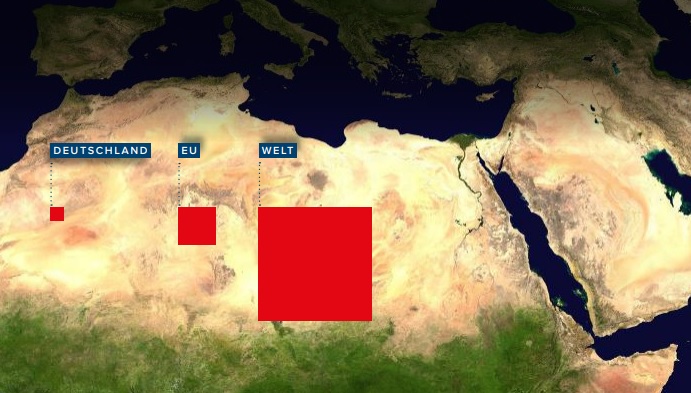
Prof. Dr.- Ing. Thomas Willner: Over a period of 30 to 40 years, it is possible to meet a substantial portion of the global fuel demand for all transport sectors (road, water, air, and rail) using waste-based fuels and e-fuels. According to a projection by the company Neste, utilizing all variants of alternative fuels could supply approximately 40% of the global fuel demand by 2040. These figures align well with our own potential assessments. Furthermore, studies have identified a significant HVO potential of more than 200 million tons per year based on Jatropha. This alone could cover the entire fuel demand of the EU. Jatropha is a plant that grows on marginal soils in desert fringes. And therefore it does not cause any „fuel vs. food“ conflicts. This creates export prospects for previously disadvantaged countries. Additionally, cultivating Jatropha enables further CO2 sequestration potential, as the plants are grown in areas where no vegetation existed before. This results in a negative carbon footprint for the fuels produced from them. Looking beyond the 40-year horizon, the entire global fuel demand can be met if the production of e-fuels is scaled up simultaneously. The Fraunhofer Global PtX Atlas shows that the socio-economically feasible e-fuel potential, at 57,000 TWh per year, is greater than the global oil consumption of around 54,000 TWh per year. See also page 8 – Background Paper – Fraunhofer Global PtX Atlas. Currently, however, EU investments in these technological fields are being heavily obstructed. The primary issue is the CO2 fleet emission standards. In these regulations, electric vehicles are credited with zero CO2 emissions, regardless of how much coal-fired power is involved. Conversely, internal combustion engine vehicles are calculated as purely fossil-based, regardless of the proportion of renewable components blended into the fuel.
Note eFuelsNow : In March 2026, the Karlsruhe Institute of Technology (KIT) published a high-profile study which concluded that Europe’s total demand can be met using waste-based fuels.
Are there already examples today where reFuels have replaced fossil fuels at a high percentage?
eFuelsNow: Yes, there are. In California, 70% of the total diesel consumption was already substituted by HVO in 2025/26 (see the green graphic below and the video commentary by Prof. Dr.-Ing. Thomas Koch from the reFuel division of the Karlsruhe Institute of Technology – KIT). Another example is Norway, where up to 45% HVO is already being blended into standard diesel. Over the course of the entire year, approximately 25% of all diesel for road transport is substituted by HVO.
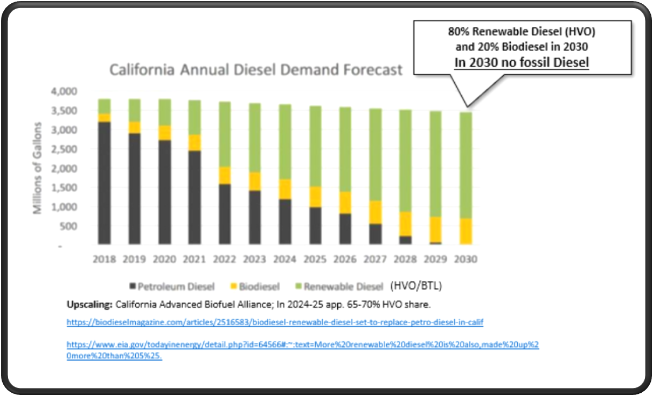
Green: HVO / Renewable Diesel
Yellow: Biodiesel (FAME)
Black: Fossil Diesel



Does HVO have a „food versus fuel“ conflict? What is HVO made from?
Prof. Dr.- Ing. Thomas Willner: HVO is produced from residual and waste materials. These can include, for example, waste fats, inedible food waste, or tall oils. There are no ‚fuel vs. food‘ conflicts with HVO, as these residues are not cultivated. This fact is verified and documented annually in the evaluation report of the Federal Office for Agriculture and Food (BLE). Furthermore, there is the possibility of using non-problematic cultivated biomass, such as Jatropha. This oil plant grows on land that is unsuitable for arable farming (for further details, see the ‚Available Volumes‘ section).
Does HVO have a palm oil problem?
Prof. Dr. – Ing. Thomas Willner: Palm oil is not used in Europe for biodiesel or HVO production, as it has not been counted towards the greenhouse gas quota since 2023. For Germany, this is documented in the evaluation report by the Federal Agency for Agriculture and Food.
Note from eFuelsNow: Palm oil is also already present in many foods. We consume palm oil on a daily basis. It is therefore surprising that criticism of palm oil is always very one-sidedly limited to fuel.
Can HVO100 be used in any diesel vehicle and do I need any lubricating additives?
Dr. – Ing. Olaf Toedter: HVO is a highly compatible fuel that can be used in 99% of all diesel engines. There are only very few cases where problems could arise in rare instances. These include, for example, rare high-performance diesel engines. However, we are not aware of any specific cases. The Karlsruhe Institute of Technology (KIT) has also conducted a long-term study covering 800,000 kilometres of driving in a haulage company. The results were very positive. We also run our institute fleet and our private cars exclusively on HVO100. The fuel meets or even exceeds all standard properties of normal standard diesel. It is only 6% lighter. However, due to the higher cetane number, there are only minor differences in consumption (if any). Positive long-term experiences from Scandinavia and California are already available. The fuel has been sold there for over 10 years. Due to very high legal blending requirements, it is used millions of times a day, regardless of manufacturer approval. There are also no differences in terms of lubrication properties. This is because HVO100 at petrol stations complies with the legal standard DIN EN 15940. Lubricating additives are part of the regular production process. As a result, HVO100 sometimes even achieves better lubrication properties than fossil diesel.
Does it make sense to use a lubricating additive when using HVO?
eFuelsNow: As Dr Toedter already mentioned, the lubricating properties of HVO are equivalent to those of normal B7 diesel fuels. In some cases, they are even better. We have already driven many hundreds of thousands of kilometres with HVO100. We have NEVER used lubricating additives and have never had any problems. HVO approved in Europe always complies with the DIN EN 15940 standard and therefore always has a lubricating additive added at the refinery. The lubrication values are far from the critical limits. In the worst case, additives can even degrade the product properties of HVO. The injectors also work very well with HVO. An Alfa Romeo 159 used at eFuelsNow reached a mileage of 440,000 km in February 2026 with the first fuel pump and the first set of injectors. Of the 440,000 km, about 55% had been covered with HVO100. The fuel pump was never replaced or sealed over the entire mileage. As a preventive measure, one injector was replaced at 440,000 km. On average, the injectors have a lifetime of approx. 250,000 km. The Alfa was able to drive almost 200,000 km longer. The first fuel pump is still in use and has never been sealed. The vehicle does not have any HVO/XTL approval.
Can e-fuels be used in any engine?
Dr.- Ing. Toedter: E-fuels are fuels without a crude oil fixed point. These fuels can be optimally adapted to engine requirements. This means that there will be no problems whatsoever with e-fuels in the vehicle fleet. Tests have already begun with positive results.
Can reFuel gasoline (e.g., made from bionaphtha) be used in every gasoline engine?
Dr Toedter: Petrol fuels with waste-based additives (e.g. Bionaphta) are very compatible fuels, similar to HVO in the diesel segment. However, the availability of such petrol fuels is still very limited. As a rule, 10% ethanol is added to achieve a higher CO2 reduction. Such E10 additives are compatible with 95% of all current petrol vehicles. Nevertheless, it should be ensured that approval in accordance with DIN EN 228 has been obtained. However, this relates exclusively to the ethanol content (not to the bio-naphtha additive).
When will e-fuels be available at gas stations?
Dr. – Ing. Olaf Toedter: The technology is already tried and tested and established. The only decisive factors for its scaling up are economic and regulatory frameworks. Equal consideration of greenhouse gas reduction in all sectors, along with taking import requirements into account, would accelerate the scaling up. Outside the EU, several facilities are in operation and even more are under construction.
eFuelsNow: A graphic showing current e-fuel projects is linked below. Click on the button.

Why is the German HVO network not as well developed as in Italy?
eFuelsNow: This is related to regulations in Italy, which have always been significantly more open to different technologies. Furthermore, Germany (as of the end of 2025) is one of the last countries where Super E5 is still legally required. This blocks tank capacity. However, 95% of all registered gasoline vehicles could easily run on E10. Ultimately, the expansion of the refueling network also depends on the GHG quota in the fuel sector. In the past, this quota was considerably less ambitious in Germany than in other countries. This demonstrated a clear contradiction, as a reduction in CO2 emissions was being demanded very loudly.
Why are countries such as France and the United Kingdom also slow to expand their HVO fuel network? Italy, Spain and the Scandinavian countries, on the other hand, are much faster.
eFuelsnow: The varying expansion of the refuelling network is probably also related to self-sufficiency rates and geopolitical considerations. Countries such as Italy, Spain, Sweden and Finland do not have significant oil production of their own. They had to import fossil oil. However, there are many sawmills with wood waste in Northern Europe. Therefore, there was great interest in producing fuels from domestic raw material sources. Research into possible substitutes began very early on. In contrast, the energy companies in France and Great Britain have their own oil platforms. But even in these countries, there is a growing rethink.
How extensive is the network of petrol stations for petrol-powered vehicles?
eFuelsNow: The latest generation of renewable petrol fuels (such as HVO or e-fuel) are not yet widely available. One reason for this is the high demand for diesel. That is why they started with diesel. You can find reFuel petrol in our app. However, first-generation biofuels (ethanol) are already widely used around the world. In Brazil, 25% ethanol is added to regular petrol. Many vehicles also run on E100. In India, E20 can be found at every petrol station. And in many US states, E15 is also mandatory at every petrol station. Due to the regulations described in numerous leading markets, modern petrol engines have long been factory-designed for petrol fuels containing up to 25% ethanol. The petrol station network is already well developed. India is the third-largest petrol station market in the world and sells E10 at over 100,000 stations. Brazil has 42,000 stations. In contrast, Germany has a network of only 14,400 petrol stations, which could easily be supplied. This fact shows once again that Germany could be much further ahead if it wanted to be. The demands for a reduction in CO2 emissions in transport would therefore be very easy to implement. All that would be needed is for those political actors who proclaim this goal most vociferously to finally abandon their paradoxical blockade position. It should be noted that, in addition to HVO and E85, there is already a very dense network of filling stations across Europe offering biogas with 90% CO2 reduction. In Europe, approximately 4,200 stations already enable 90% CO2-reduced driving with petrol engines. E85 is available at approximately 6,000 filling stations (including 20 stations in Germany).
The video shows the development of the HVO fuel network between 2023 and January 2025. Current figures can be found in the App and on the HVO fuel station map (website).
—