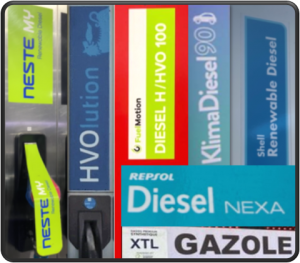
This is a synthetic diesel fuel made from 100% renewable sources. HVO is NOT biodiesel! (See video below to see the difference)
European fuel pumps are labelled as „HVO“ or „HVO100“ plus the additional designation „XTL“ according to standard „DIN EN 15940„. A brand name is also often included (e.g., NesteMy, HVOlution).
The labels „HVO100“ and „XTL“ clearly indicate that it is 100% pure HVO fuel.
If „HVO“ and „XTL“ are indicated, it may in individual cases also be HVO93 with 7% biodiesel admixture.
HVO100 in Europe legally complies with the DIN EN 15940 standard and contains appropriate lubricating additives that protect the engine. Additional additives are not necessary. They are unnecessary and can impair fuel properties. If you still need to use an additive, make sure it is compatible with HVO100.
HVO100 is usually odorless and water-clear
With HVO100, (especially older) engines run significantly quieter and with higher performance.
The fuel is particularly suitable for vehicles with long periods of inactivity (classic cars, camping vehicles) due to its resistance to diesel bug.
________________________________________
Reduction of emissions
Values from manufacturers such as Neste
Balanced savings of up to 95% less CO2
33% weniger Feinstaub (+ weniger Partikel)
33% less fine dust (+ fewer particles)
30% less hydrocarbons (HC)
24% less carbon monoxide (CO)
Reduced emissions of polycyclic aromatic hydrocarbons
Older cars up to approximately Euro 6b achieve better local emissions.
Newer diesel vehicles (e.g. Euro 6d) do not improve local emissions because they already have a very efficient cleaning system.
In all diesel vehicles, the exhaust gas purification system is significantly relieved by the use of HVO.
Analysis of an engine after 60,000km HVO100
HVO <-> Biodiesel
TV report by Bavarian Broadcasting (in German language)