The map is created by one eFuelsNow group member out of deep passion and inner conviction.
In the following text, the creator of the map explains his motivation:
As an engineer, you work with scientific principles throughout your studies and career. It’s a creative profession. As an engineer, I want to utilize all available technological possibilities for the benefit of the environment and our customers. As a passionate driver, I’ve traveled through many countries where renewable fuels like HVO have been available for years. I’ve noticed that German „climate protection“ organizations and their political representatives have been complaining about CO2 emissions from transportation for a long time. At the same time, however, they are blocking all technological solutions. This is why many people are asking serious questions. Is this even about climate protection, or is it about something else? HVO100 has been available at gas stations in Northern Europe and California since around 2013. However, it wasn’t allowed to be sold in Germany until May 2024. Technically unfounded justifications were given for this ban. Similar patterns can be seen in other areas (e.g., the years-long blockage of climate-neutral CCU/CCS power plants, or the incomplete consideration of CO2 and efficiency in vehicle propulsion systems, including vehicle and infrastructure footprints, electricity generation, etc.).
The primary purpose of the map is scientific, to assist universities in observing the tank network. At the same time, it aims to make the supposedly „non-existent refueling stations“ clearly visible to everyone. Measures to reduce CO2 emissions must be evaluated honestly again. This means focusing on energy, according to market and scientific principles. Climate protection has to do with energy, but nothing to do with powertrain systems. Every powertrain can be decarbonized. However, not every powertrain is suitable for every customer. Only an honest perspective can counteract the socialist instrumentalization of environmental protection.
And that brings us to a very, very important issue: strengthening the social market economy. The honorable cause of environmental protection must not be allowed to degenerate into a socialist bludgeon.
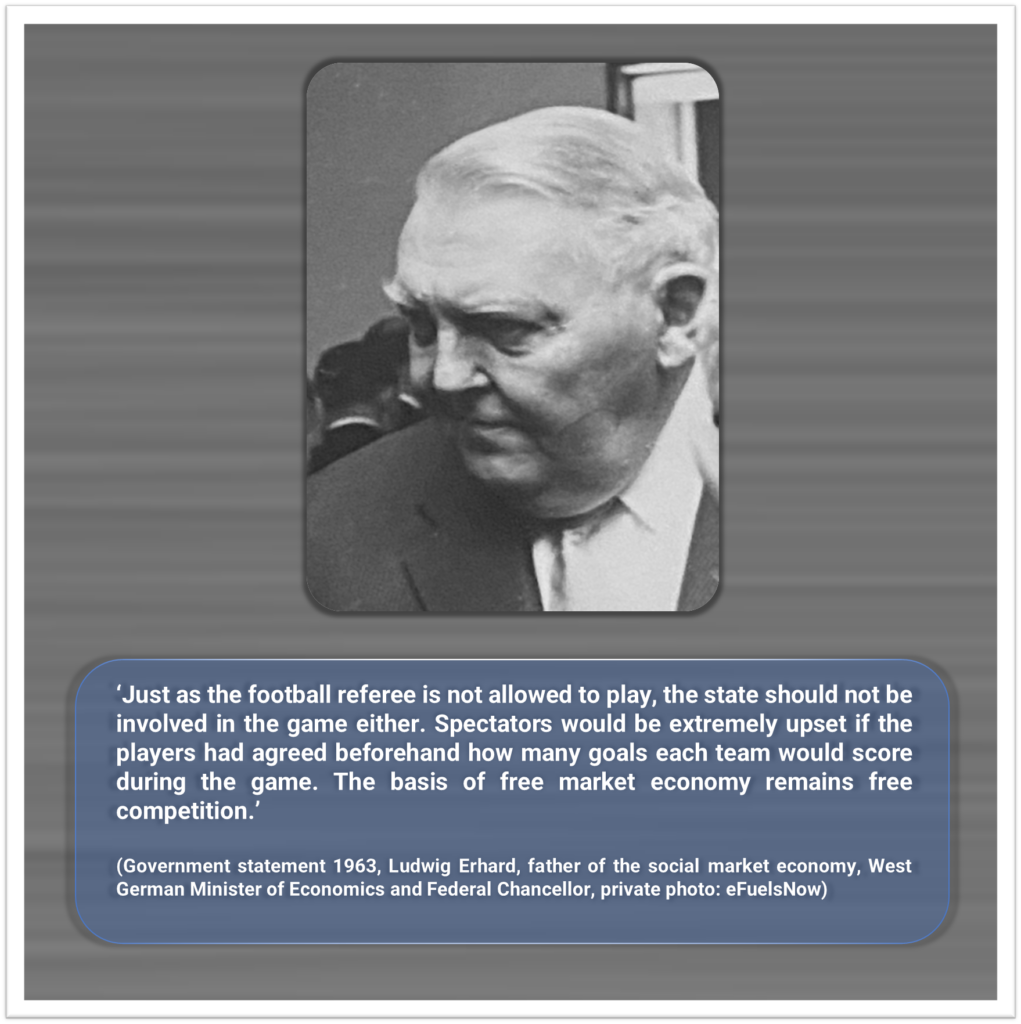
The photograph of the man pictured below comes from my own photo album. I know firsthand what our legendary German Minister of Economics and Chancellor Ludwig Erhard’s goal was: to provide honest help to the worker. Because in our West German capital, Bonn, they understood that honorable causes must not be exploited. The dishonest and failed counter-example from the Eastern Bloc is still well known. That is precisely why, today, we must also provide honest help to the environment (and to the worker). The word „minister“ comes from „to serve“ (Latin „ministrare“). In a market economy, the state service provider sets the goals exclusively in consultation with its client (the citizen). Customers and engineers decide individually on the path to achieving them. In market competition, the best product always wins because only application and product experts make the decisions. A counter-example: In countries with planned economies characterized by shortages, state intervention in the market was also misused as a monopoly of power („Only if you are obedient will you get what you want.“). This is diametrically opposed to the values of an enlightened Western society in the 21st century. There’s no need for rationing when there’s more green energy available globally than the world needs (see also the DLR graphs). You simply can’t save the global climate with scarcity. Environmental protection requires money and people willing to participate. Therefore, we need to return to thinking more like Ludwig Erhard. We need more tolerance for diverse technologies, as well as customer focus and a pragmatic approach. We need more. We need to return to the approach that made West Germany and Western Europe successful.
This card is dedicated to the person who taught me all these connections (my grandfather) as well as to the father of the social market economy, Ludwig Erhard (whom he knew personally).